Sunday, 20 January 2013

(Not Quite) Six Feet of Snow


It is very rare that it snows all through the daylight hours here in Bethnal Green. It's very wrong indeed. But we put Ski Sunday on the television to match.
The onset of snow is a thrill, no doubt about it, Ooooh we go, Aaaah we go. That white blanket is both indicatively fresh and experientially unusual. We've even light candles, and Julie's gone for the Kalua.
We went out to Columbia Rd, our usual Sunday penance, but this time there's blokes, Italians, literally falling over themselves to take photographs of me and even some mad lady with leaflets for the British Museum (something about an Ice Age) says she loves my look!...Such a kind face!! she says, like I'm some kind of dog. At this point Julie's face is dark with thunder. I don't generally put on a look for anybody, although I understand it is not done to go out in Shoreditch without full regalia looking like something out of the nineteen forties in ginger hair whipped up like a French horn. I probably looked kind because there were no idiots duetting barbershop and no ukulele strummers and no busking Joe Strummers that usually really piss me off. That was a relief mistaken for benevolence.
After all this admiration, all caused by fortuitous weather conditions, we came home to savoyarde potatoes and bacon. Nothing like going with a theme.

Thursday, 17 January 2013

Errors

Like building, marking goes on and on, and it seems to take inexorably longer the closer you get to the bottom of the pile. And with dissertations, you long for all authors to consider calling a spade a spade, or at least justify it's consideration as a shovel in pert, neat, terms. There are some concerns that demand the contrite, such as Walter Gropius was good in bed, that offers massive illumination in one short phrase, or that Aldo Rossi was a bad driver (Rossi suffered two car accidents, leading us to all kinds of speculation, but we know the first changed his view on architecture- the city, like his body, was fractured- and the second killed him). There is much to the bleeding obvious, such as, if you'd spent four years 1914-18 covered in shit in a trench, you'd want to paint everything white, and if you'd spent WW2 being rained on by bombs you'd immediately want everything built of solid concrete. It's really not that hard, but you would not imagine the contortions some people go through to say over twelve thousand mind numbing words what can be said in one simple sentence.
Right now of course, it's easy to see, for instance, that the High St is dead and computers killed it. It's easy to see that life is now crying at home and shopping on line, and that anything else just 'pops up', like mime festivals or now you see it now you don't Latvian cuisine. Popping up means of course that it soon pops down, hence the crying bit. However, you try building a pop-up old peoples home. Dear dear dear, education education education, a rose is a rose is a rose, which of course it isn't by the time you've said that, it's something else, and of course it's often what's left out, like in reggae or Richards riffs that's important.
I discovered today that Sigfried Giedion, that most accomplished scholar, in his monograph of Gropius published in 1954, omits sex bomb Alma Mahler, his first wife, entirely from his story (there is only the tiniest, most perfunctory mention slipped in at the back). It's like she didn't exist, she is abstracted out. How curious. There's plenty about his wonderful genes, about his heritage, even going back to the effect on Germany of the thirty years war! Spooky. It's like 'Vot! Zerr vill be nose emotions!!' What does that say about the image of a great architect?

Sunday, 13 January 2013

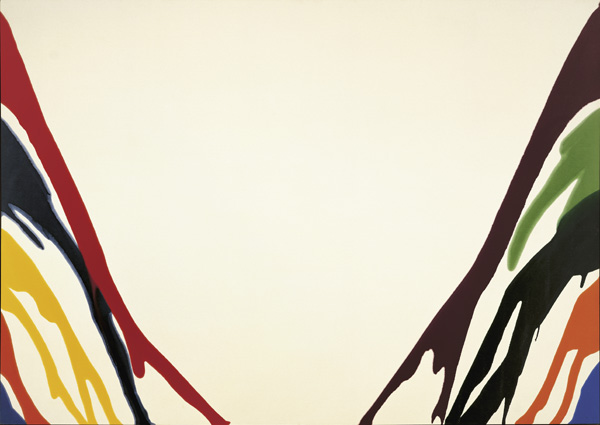
Morris Louis


Morris Louis was only 49 when he died in '62. When he died he left 422 paintings, which he did in the kitchen while his wife was out, rolled up in the house, 230 of which he painted in his mature 'great' period in just 16 months. He was a bit secretive about his painting, and you wont find many quotes by him even on the web; perhaps because even he thought he was mad, or just shy, as he pioneered the 'post painterly abstraction' that would make him, posthumously, a genius. It is remarkable he 'painted' them in the kitchen, for some of them are very large indeed. His methods are also largely secret but involved (clearly) soaking, daubing, rubbing, dragging and folding. He didn't sell many of his paintings at the time, he taught art in college, which must prove he just loved doing them for doing them's sake no matter how awkward the circumstances. And he didn't live in New York, but the relative backwater of Washington DC. Other people made him famous.
The one thing unsurprising about Morris Louis is that he died of lung cancer brought on by paint fumes. The most his wife might have known as she returned to the tidied kitchen was the lingering smell.
Anybody could do it, well yes, anybody could, but they couldn't could they.  

Spike Milligan and History


Possibly the best books on WW2 are Spike Milligan's memoirs Vols1-4, starting with Adolf Hitler My Part In His Downfall. This is a highly contentious statement, some people annoyed Milligan by saying he was unreliable but even then went on to write their own autobiographies as 'Unreliable Memoirs' (Clive James). What a bitchy world. Milligan admits his truth is a bit jazzed up, but he was at least there, and his unflinching attempts to entertain us with the sheer tedium, misery and desperation are revealing not only of the desperation of the war itself, but also in him. At the end of Vol4, he's sectioned.
That is not to say that we should all appreciate history as if watching Night At the Museum II, which I thought was hugely funny, lisping Pharaohs and all, last night. Lisping Pharaohs is jazzing it up a bit, but jazzing it up well to be sure. You can make a lot of the difficulty with history. In his recent book on Reinhard Heydrich, 'HHHH', Laurent Binet begins to annoy you with it. In it his concerns, the authors concerns, while entertainingly post modern, or at least entertaining to Martin Amis, could be said to detract every so slightly from the evil of Heydich himself, and that could be said to be no good thing. It must be a question of balance and intension, because with post modernism, values are apt, ever so slightly, to disappear.
The thing about history is of course that any biographer would give eye teeth to know that 'Jesus raised his left eyebrow just a little when he was interested in something somebody said' but we shouldn't make such a huge song and dance about not knowing that and having to be creative somehow (this is also a hugely contentious statement) we understand that we are stuck, not to get Buddhist about it, in the here and now, in this case stuck in Bethnal Green, 11.24am, Jan 13th. If we weren't, as one of my students very perceptively said last week, and with one eyebrow quisically raised, and we were time travelling as in Back to the Future II, we would all be crashing into each other and it would be very dangerous. In one fell swoop she demolished any possibility of time travel. Time travel doesn't make any mathematical sense, since there cannot be two things in the same place at the same time, and actually, I don't want to be in Milligan's sodden tent or in his sodden boots either.
However time travel does make perfect literary sense.

Friday, 11 January 2013

A Place of Learning

My first architecture studio was situated in the inner sanctum of the Wills Building, Bristol University, a  faux victorian gothic for a faux Oxbridge, all paid for by a cigarette manufacturer. How curiously appropriate. But architectural studios from the AA to Glasgow to Liverpool to Bath fair little better in demonstrating fitness for purpose even given their reputations as some of the finest architecture schools in the world.
This paradox perhaps illustrates that an ideal place of learning is elusive. We learn everywhere, and we learn informally, in pubs, walking down streets, in front of television and now we Google whatever we need.
When asked to demonstrate the 'new' world of working and learning for 'New Labour' for a zone in the Millennium Dome (I had met WORK director Tim Pyne on election night 1997- the rest is history- see 'Sitting in the White Horse Thinking about a White Elephant' The Tragic in Architecture, Patterson R, 2000) it became clear that we were significantly in a world of what would become termed SPIN. Maybe we didn't personally care at that time, the realisation would dawn in my case slowly, but the imperative was certainly for information to be delivered 'on message' and this was a terrible pain in the arse, especially if the message was rather dubious. At this point Joseph Goebbels statement, that the best propaganda is that which the audience does not notice, becomes highly pertinent.
At the time I had also learnt a great deal from Las Vegas. This knowledge might be paraphrased, without much ad do and with apologies to Giedion (1948) as 'Economics Takes Command'.
The positive spin of New Labour has given way, post 9/11 to the all pervasive vagaries of the Shock Doctrine and seemingly impossible conjuring tricks with economics. We are tumbled through information and emotion like we are stuck in a washing machine. Sometimes it seems that the C21st western world is based on little else but crying and shopping.
So it might be prescient to look at some examples of learning environments where there is less to hear and less to see, where the focus is more precise, and precise perhaps because of the trauma of their genesis.
Walter Gropius was an intelligent, sophisticated young man, but prone of course to the tribulations of youth just like anybody else. Not only did he have an affair and marry prototype sex-bomb Alma Mahler, he was nearly buried alive under rubble and dead bodies in WW1. If we consider his period 1915-20 it appears nothing but traumatic. He came through one of the most curious evocations of manic spirituality yet known to civilization and came through it first hand, managing it's embers in the Weimar  Bauhaus, which, as Alma noted, was noteworthy only for the stench of garlic (Itten, in his robes, had commandeered the kitchens). What we get come 1925 is the most positive crystallisation of mental clarity in the building for the Bauhaus in Dessau, a building blessed with understatement to the point of the sublime. There is no nature in the Bauhaus Dessau, there is just a demonstration of mankind's practical, hopeful (some would say Utopian) intellect. (Even then, the studios don't really work very well).
Louis Kahn demonstrates the American tradition of the organic with the Salk Institute. It doesn't necessarily look like that's what he's doing but that is what he does all the same. The building 'worships' the horizon of the Pacific ocean, the rooms for the scientists are arranged like physical crystals regularly placed as pod structures off the main structure of the workshops they serve. There are a lot of corners, building this way is expensive, but the Americans have a penchant for the super primitive and hang on tight to some notion of organic unity through the vagaries of Sullivan, Wright, Lautner, and Kahn despite all evidence to the contrary.
Alvar Aalto, at the university of Otaneimi, taps in to a more ancient humanism, reworking the most elemental of the western world's teaching spaces, the Greek amphitheatre, covering it (given the northern climate) but still providing an exterior echo of the interior form on the outside, and then racking and stacking all the ancillary stuff in a rational way around it. It proves some things will never change, no matter how much information you can download under a tree in a plastic Arcadia, you will still need instruction at some point, you will need the road map to hold it all together, and you will need a helping hand to help you see a positive way forward amidst a morass of information and tumult of emotion, and of course to see through the spin.

(Precis of a symposium introduction given to third year students on the subject of their upcoming final project 'A Place of Leaning' 10.1.2013)


Wednesday, 9 January 2013

No More Heroes?


There is surely more to the abandoning of the blue plaque scheme than squeezing of budgets. Perhaps there are no more heroes, and we are entering a sort of Logan's Run theme world. It is tempting to think this given the undoubted difficulties the blue plaque committee must have faced whenever they tried to decide who and who should not get a plaque, given that we live in times where every little bit of effort has to be cherished as heroic and nobodies heard of, say, Mick Ronson. I do like Logan's Run a great deal, but only the bits with Jenny Agutter soaked in that green dress. Should we be fighting this phenomenon to re-instate the idea of heroic progress and counter all this post-modern nonsense?
Or perhaps that it's just that as you get older it's inevitably harder, personally, to appreciate Squat Diddly Associates design for a parametric tennis court and your attention deviates more happily to contemplation of Walter Gropius's historic sexual prowess. Note post modernist architects all seemed to turn in their fifties, Jim Stirling would be a prime example. Certainly there is a point to that too, my old Professor Kit Allsopp first reduced all architecture to sheds, then reduced it to sheds in forests, and now has given up on the sheds altogether, and just paints trees. Will the sap disappear entirely? Certainly those who attempt to defy the aging process begin to look like twats, I note this happens to almost all male chat show hosts, with UK exemplars Michael Parkinson and Jonathon Ross. Ross has become a particular self parody, and anyway, how can anybody maintain that sort of interest in celebrity gossip for a whole lifetime? That seems particularly squalid. Has architecture become just celebrity gossip?
Meanwhile thinking of Mick Ronson, David Bowie pops up again to excruciate matters. He's been ill, he's sixty five, 'he just works on his music at home' but most of all he's 'the master of re-inventing himself' well you can't do that forever can you?


Thursday, 3 January 2013

Post-Human

Suddenly everybody is worried about being fat even more than they used to be worried about being fat. It's a conspiracy of course. Every hamster in charge of any January magazine knows it's time to market self-loathing. Now it's the politicians who worry. This is a big question for post-humanity, how do we evolve our idea of an NHS designed to rid scrawny kids of rickets in 1947, to one of resolving self-esteem issues with fresh breasts in 2012?
Julie took on a few solutions once, Gail Porter's 'Fat Burner Diet' was her favourite, but if you saw Gail Porter as she is now and as we spied in the holiday rags, looking not unlike Adam Ant as he appeared,  unfortunately, on Jools Holland's New Years Eve Big Disappointment, you'd realize certain celebrity solutions are not to be trusted; the lithe body that was once projected on Big Ben, and the lithe body that was swash buckling New Romantic pirate, had both ended up looking like little and large versions of Ronnie Corbett, except Gail was bald.
Certainly the economic value of hospitals has shifted, no longer a simple drain on resources, I'm sure a dump like Wythenshaw is largely supported by it's hospital, or at least that portion of NHS finances which isn't devoted to making Zurich like Zurich. Nurses are fat because there are no decent places or times set aside for them to eat properly in hospitals, it's no doubt all catering has been sold off to Mars. People who are poor are fat because they shop at Iceland because that is the cheapest place to buy food. Thankfully I'm fat because I like wine and can't drink whisky for breakfast anymore because if I did I'd be thin but then also I'd be dead.
Now they say if you're fat they'll be no more benefits unless you go to the gym. I can't think of anything more soul destroying, and I can hardly think of such unfairness to your fellow man. It is an affront to hear Tories endlessly bleating about 'storing up problems for the future' when their own self image and ideology is so resolutely located in the pre-industrial. They should look at themselves while sipping port in the easy chairs of the Carlton Club, or whilst retiring to the country seat.
Actually I can think of something more soul destroying, how about making prisoners pay for cells like hotel rooms. This is another silly season idea from conservative politicians, it would presumably allow themselves to be confined, if nicked, to five star quarters, maybe in Zurich, while the penniless rot in the clink. Well done, destroy the whole fabric of Enlightenent thought, go on...